

The function of ACS Nano co organically organic-inorganic hydrogel is used for stratified mineralization and neovascularization.
abstract
Due to the unique but complementary nature of the inherent characteristics of different components, synthetic nanostructured materials combining organic and inorganic components provide a class of unique, powerful and universal materials for wide application. Recently, Professor Marie Alvaro of Queen s University in London reported a supramolecular system based on synthetic Laponite (Lap) and peptide two affinity (PAs, PAH3), which is reasonably designed and can be assembled into nanostructured hydrogels with high structural integrity and a series of bioactive Mata.
Spectrum and scattering techniques and molecular dynamics simulation were used to confirm that the electrostatic adsorption of pah3 nanofibers was consistent with the surface of lap nanodisks. Electron microscopy and atomic force microscopy also confirmed that the diameter and surface area of pah3 nanofibers increased after CO assembly with lap. The dynamic oscillatory rheology showed that the co assembled PAH3-Lap hydrogel exhibited high stiffness and strong self-healing behavior, while gas adsorption analysis confirmed the stratification and heterogeneous porosity. In addition, this unique structure in the three-dimensional (3D) matrix provides space constraints for the nucleation and layered organization of high aspect ratio hydroxyapatite nanorods into well-defined spherical clusters in the 3D matrix. The applicability of organic-inorganic PAH3-Lap hydrogel was evaluated in vitro using human bone marrow stromal cells (hBMSCs) and chicken chorioallantoic membrane (CAM) assay in vitro. The results showed that the organic-inorganic PAH3-Lap hydrogel promoted the proliferation of human bone cells, combined with CAM after mineralization, was infiltrated by blood vessels, stimulated extracellular matrix production, and promoted a wide range of mineral deposits relative to the control. The related papers are published in ACS Nano with the title of de novo design of functional assembling organic – inorganic hydraulics for hierarchical mining and neovascalization.
Main picture
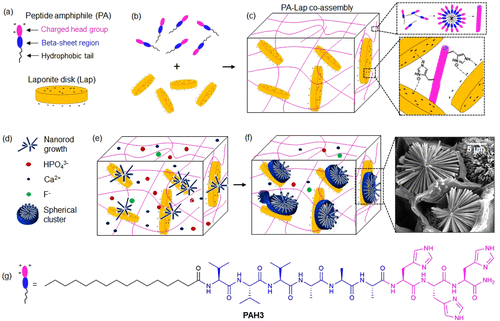
Fig. 1. supramolecular co assembly of disassembled Lap nanoplates (-ve) and PA (+ve) to create 3D hydrogels that can lead to nucleation and hierarchical growth of hydroxyapatite crystals.
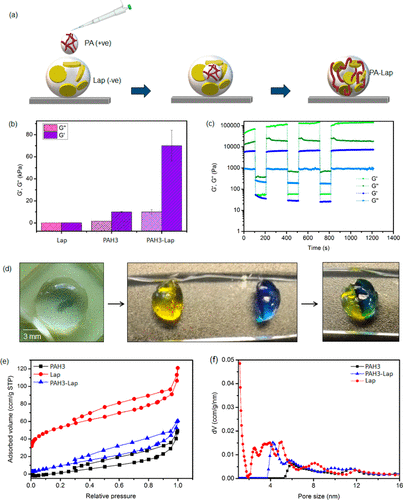
Fig. 4. the surface and mechanical properties of the hydrogel. A schematic diagram of the preparation of a) PAH3-Lap hydrogel. B) compared with PAH3-Lap hydrogel, the storage (G) and loss (G) modulus of PAH3 and Lap. C) time scanning rheometer shows thixotropy of PAH3 and PAH3-Lap hydrogels. D) optical image shows the firmness and self healing ability of PAH3-Lap hydrogel. N2 adsorption isotherms of E) PAH3 (square curve), Lap (circular curve) and PAH3-Lap (triangular curve) xerogels. F) cumulative pore volume of PAH3, Lap and PAH3-Lap xerogels.
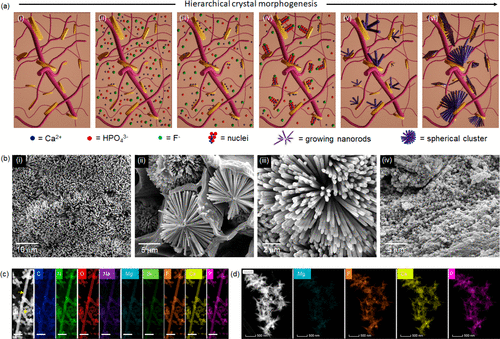
Fig. 5. biomineralization in hydrogels.
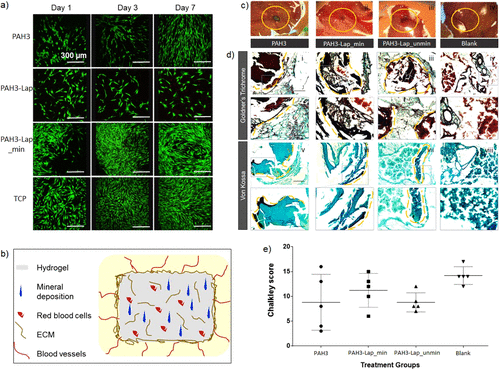
Fig. 7. biological applicability of PAH3-Lap hydrogel.
summary
The team developed a co assembled organic-inorganic hydrogel platform for crystal growth in vitro, mediated by the particle attachment mechanism in the 3D supramolecular restriction framework. The design strategy depends on the electrostatic interaction between Lap nanoscale and cationic PAH3 molecules to integrate the intrinsic characteristics of organic and inorganic components into unique organic inorganic hydrogel structures. The obtained materials show high surface area, high mechanical properties and self repairing properties. In addition, the co assembled PA-Lap hydrogel shows a nano scale structure which can be used as a sealed space for hydroxyapatite to grow from ordered nanorods to well-defined spherical clusters. This study explored this mineralization mechanism as a biomimetic 3D model to regulate the nucleation and spatiotemporal organization of FHA.
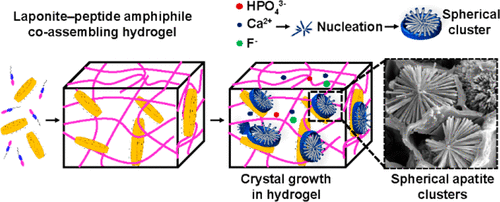
This model is used to understand the role of Lap nanoshels and PAH3 nanofibers in PAH3-Lap hydrogels in guiding the growth of hydroxyapatite nanorods at multiple lengths. At the atomic level, the mineralization of pah3 lap depends on the diffusion driven process, in which the local ion concentration and supersaturation are mediated by supramolecular interaction with lap. In addition, the nanoscale structure of PAH3-Lap hydrogel promotes the embedding of nanorod crystals and then grows into unique spherical clusters at the micron scale. Interestingly, these mineralized PAH3-Lap nanocomposite hydrogels were superior to all control groups in supporting cell growth, stimulating cell entry, vascular invasion, ECM production and mineral deposition in the CAM model. In addition to these advantages, the shear thinning properties of the system make it a suitable material for bio ink for 3D printing applications. In general, this study proposes a nanotechnology approach to design integrated and high-order self-assembled nanomaterials, which has potential applications in regenerative medicine.
This information is from the Internet for academic exchange only. If there is any infringement, please contact us to delete it immediately
18915694570
Previous: ACS Nano: magnetic nan