

Angiosteosis-HA PAM
Hydroxyapatite-binding micelles for the detection of vascular calcification in atherosclerosis
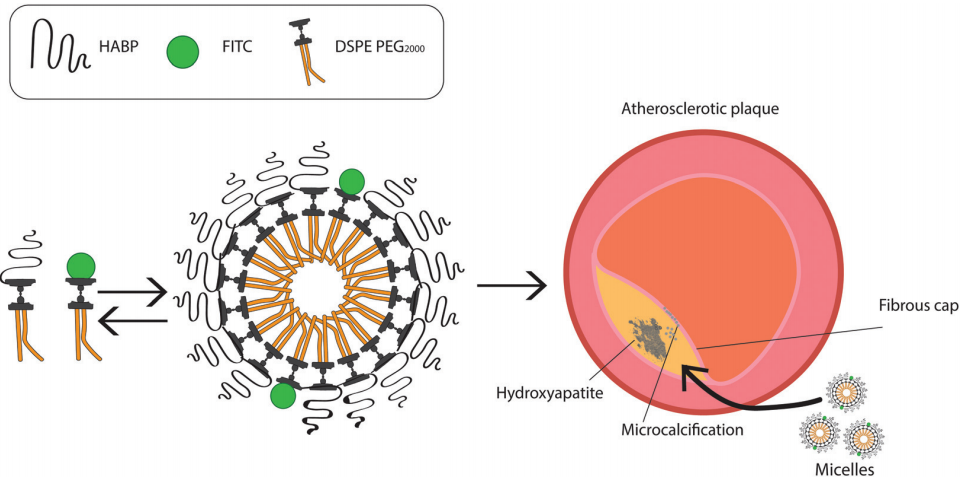
Atherosclerosis is a chronic disease characterized by the formation of calcified arterial plaques. Microcalcification (5 μ m to 100 μ m) is mainly composed of hydroxyapatite (HA, Ca 5 (PO4) 3 (OH)), formed in the fibrous cap of atherosclerotic plaques, causing plaque rupture due to loss of compliance and elasticity. Eventually, plaque rupture can cause arterial occlusion and embolism, and lead to ischemic events, such as stroke and myocardial infarction. Unfortunately, current imaging techniques used to detect calcification are limited by a low signal-to-noise ratio or by the use of invasive procedures with a risk of arterial dissection. To mitigate these drawbacks, in our study, we developed a novel fluorescently-labeled peptide amphipathic micelle (PAM) using a 12-amino acid HA binding peptide (HABP) to target and detect atherosclerotic calcification (HA PAM). Our results show that HA PAM can successfully target HA microcrystals in vitro with strong binding affinity (KD = 6.26 ± 1.2 μ M). In addition, HA PAM detected HA mineralization of calcification of mouse aortic vascular smooth muscle cells (MOVAS) formation (HA PAM and non-targeted micelles, p 0.001; HA PAM and stray HABP PAM, p 0.01).
18915694570
Previous: BK Engineering Bacteri
Next: Revascularization-β-HS