

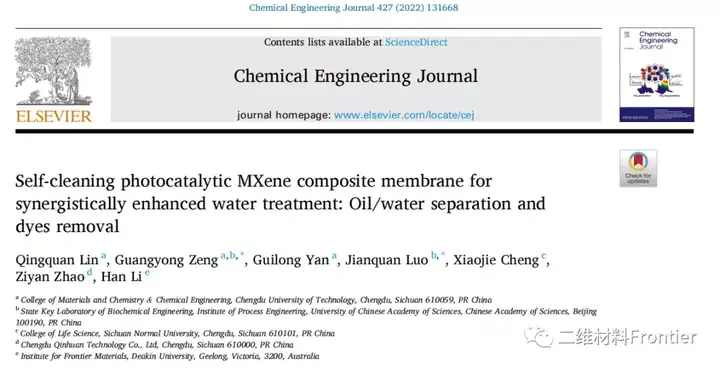
Self-cleaning photocatalytic MXene composite membrane synergistically strengthens water treatment: oil-water separation and dye removal
1. Article overview
Membrane separation technology has been widely used in water treatment, but in practical applications, the accumulation of contaminants on the membrane surface is still inevitable. Photocatalytic technology is an effective and environmentally friendly pollutant degradation method. Here, we report a simple method to prepare a new two-dimensional (2D) Bi2O2CO3@MXene photocatalytic composite film and its multifunctional ability in water treatment. The experimental results show that after doping with N-doped Bi2O2CO3 nanoparticles (815.3L⋅m−2⋅h−1), the composite membrane has an ultra-high water flux. The interception rates for the three different types of oil-water emulsions are all above 99%, and excellent dye removal rates are obtained through membrane separation, adsorption and photodegradation, which are respectively about 99.9% (Congo Red), 98% (Taiban Blue) and 98.4% (Rhodamine B). The most important thing is that the composite membrane still maintains stable permeability and selectivity after 5 consecutive cycles under visible light irradiation. Through density functional theory (DFT) calculation and finite element method (FEM) analysis, the mechanisms of improving photocatalytic activity and membrane permeability were revealed respectively.
Two, graphic guide
Membrane separation technology has been widely used in water treatment, but in practical applications, the accumulation of contaminants on the membrane surface is still inevitable. Photocatalytic technology is an effective and environmentally friendly pollutant degradation method. Here, we report a simple method to prepare a new two-dimensional (2D) Bi2O2CO3@MXene photocatalytic composite film and its multifunctional ability in water treatment. The experimental results show that after doping with N-doped Bi2O2CO3 nanoparticles (815.3L⋅m−2⋅h−1), the composite membrane has an ultra-high water flux. The interception rates for the three different types of oil-water emulsions are all above 99%, and excellent dye removal rates are obtained through membrane separation, adsorption and photodegradation, which are respectively about 99.9% (Congo Red), 98% (Taiban Blue) and 98.4% (Rhodamine B). The most important thing is that the composite membrane still maintains stable permeability and selectivity after 5 consecutive cycles under visible light irradiation. Through density functional theory (DFT) calculation and finite element method (FEM) analysis, the mechanisms of improving photocatalytic activity and membrane permeability were revealed respectively.
Two, graphic guide
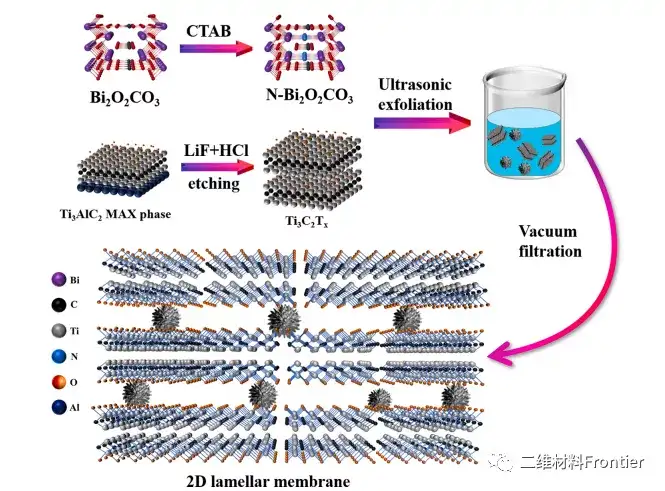
Shown in Figure 1. Schematic diagram of N-Bi2O2CO3@MXene/PES composite membrane process.
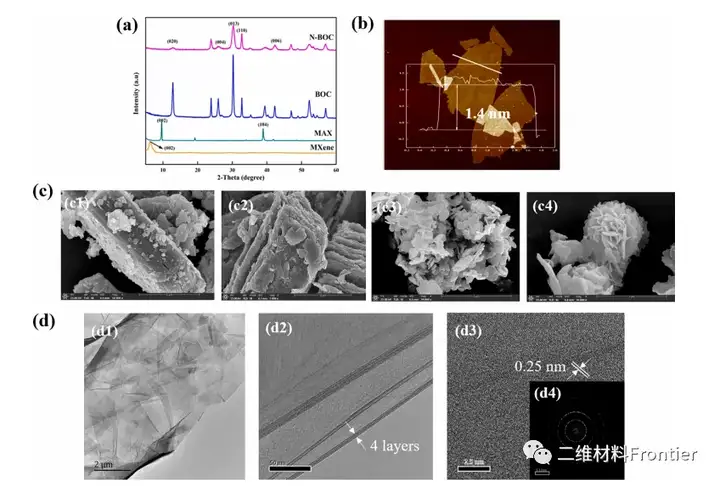
As shown in Figure 2. (a) XRD spectra of MAX (Ti3AlC2), MXene (Ti3C2Tx), BOC and N-BOC; (b) AFM image of MXene nanosheets; (c) MAX (c1), MXene (c2), BOC (c3) And SEM images of N-BOC (c4); (d) TEM images, HRTEM images (d3) and SAED images (d4) of MXene nanosheets at different magnifications (d1 and d2).
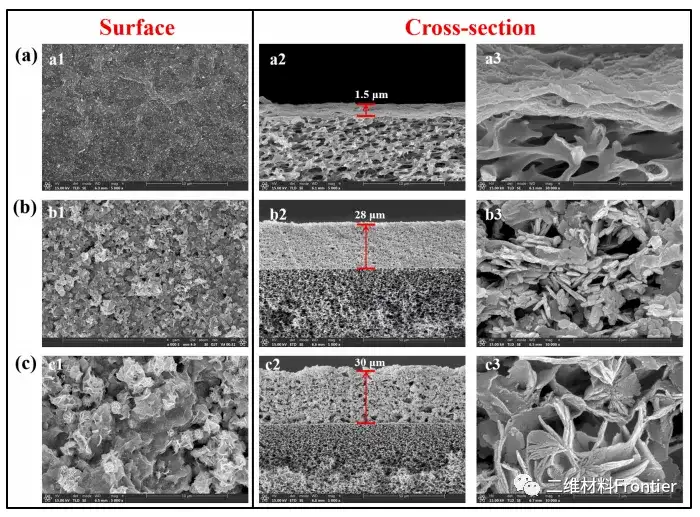
Shown in Figure 3. (a) MXM, (b) BMXM and (c) N-BMXM surface and cross-sectional scanning electron microscope images.
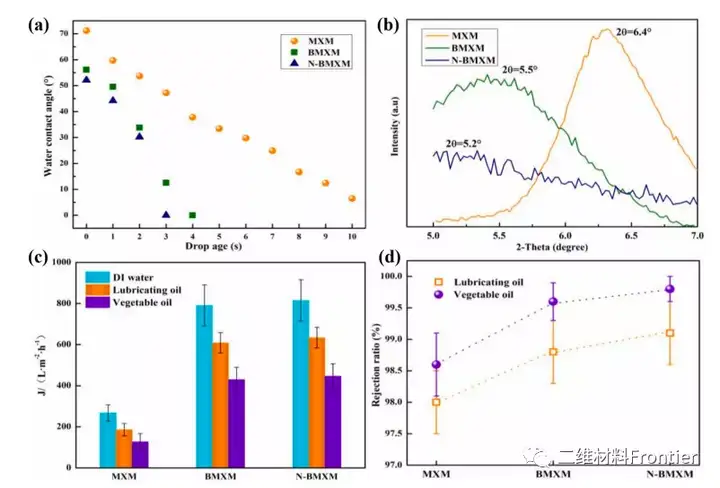
Shown in Figure 4. (a) Water contact angle of different membrane dropping age; (b) XRD of composite membrane, (c) flux of pure water and O/W emulsion, (d) oil rejection rate of membrane.
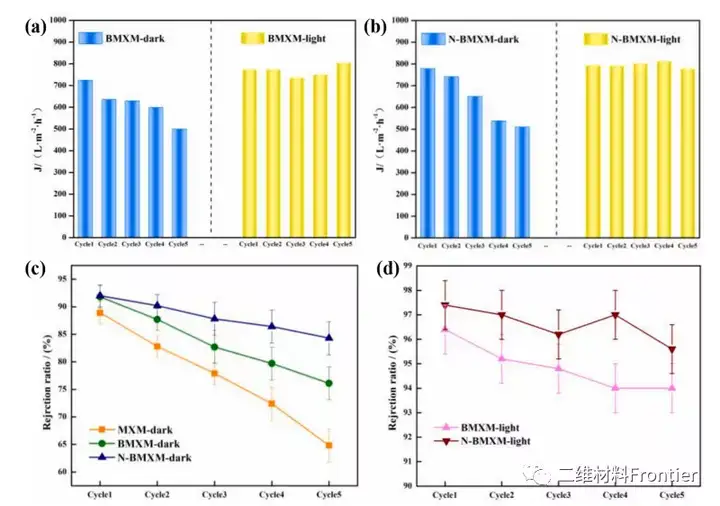
Figure 5. Flux of BMXM (a) and N-BMXM (b) under dark and visible light; BMXM and N-BMXM rejection rates and repeated use cycles under dark (c) and visible light conditions (d).
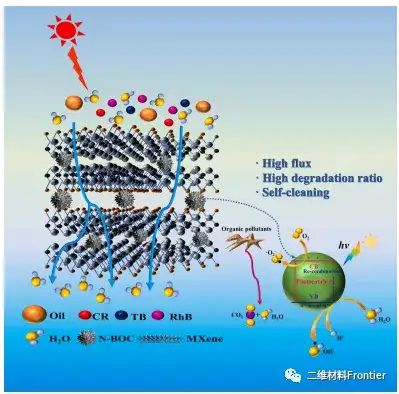
Shown in Figure 6. Separation and photocatalytic degradation mechanism of NBOC@MXene/PES composite membrane.
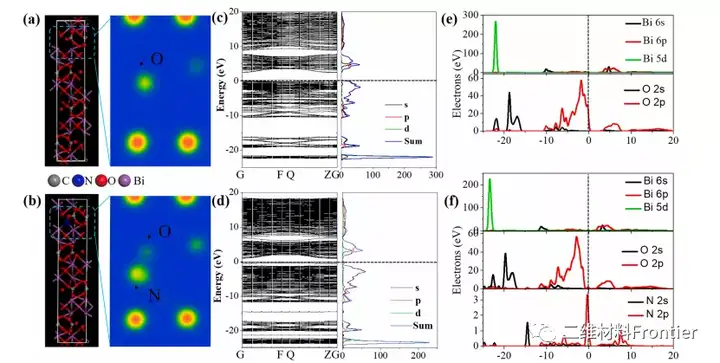
Shown in Figure 7. The crystal structure and electron distribution of Bi2O2CO3 (a) and N-Bi2O2CO3 (b) The energy band structure and density of states of Bi2O2CO3 (c) and NBi2O2CO3 (d); the conduction band and valence of Bi2O2CO3 (e) and N-Bi2O2CO3 (f) belt.
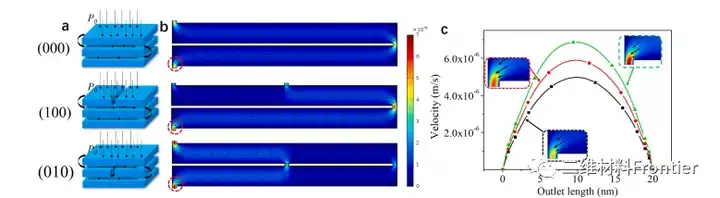
Shown in Figure 8. Finite element analysis of water flow in MXene fractures: (a) Three-layer MXene three-dimensional model with and without defects. 0 means no defect, 1 means defective; (b) the velocity distribution of water flow in the MXene fracture when different defects such as (000), (100), (010) are formed; (c) the water flow velocity distribution under the conditions of different defects. The inserted image is the enlarged velocity distribution around the outlet. Third, the full text summary
In summary, a series of photocatalytic composite membranes have been successfully prepared using a simple vacuum-assisted filtration method. Due to different separation mechanisms, the membrane exhibits multifunctional separation performance for different wastewaters such as insoluble oil/water emulsions and soluble organic dyes. The results show that under the condition of 0.1 MPa, the permeability of the composite membrane is 815.3 L⋅m−2⋅h−1, and the oil removal rate and dye removal rate are both high, breaking the balance between selectivity and permeability. This is due to the increase in interlayer spacing and permeation channels. In addition, the interception rate of the N-Bi2O2CO3@MXene/PES composite membrane for the oil-water emulsion in wastewater is close to 100%, and the removal rate of different dyes by the composite membrane exceeds 98% under visible light irradiation. More importantly, after many cycles of tests, the composite membrane has good recyclability and self-cleaning ability. DFT simulation shows that the doping of N element has a positive effect on improving the photocatalytic activity. The two-dimensional/two-dimensional heterojunction structure between NBOC and MXene also promotes the excellent photocatalytic activity of N-BOC. This article studies the use of the synergistic effect between two-dimensional materials and photocatalysts, and provides a new strategy for the design and development of multifunctional membrane materials. Article link: https://doi.org/10.1016/j.chemosphere.2021.131916
This information is sourced from the Internet for academic exchanges only. If there is any infringement, please contact us to delete it immediately.
In summary, a series of photocatalytic composite membranes have been successfully prepared using a simple vacuum-assisted filtration method. Due to different separation mechanisms, the membrane exhibits multifunctional separation performance for different wastewaters such as insoluble oil/water emulsions and soluble organic dyes. The results show that under the condition of 0.1 MPa, the permeability of the composite membrane is 815.3 L⋅m−2⋅h−1, and the oil removal rate and dye removal rate are both high, breaking the balance between selectivity and permeability. This is due to the increase in interlayer spacing and permeation channels. In addition, the interception rate of the N-Bi2O2CO3@MXene/PES composite membrane for the oil-water emulsion in wastewater is close to 100%, and the removal rate of different dyes by the composite membrane exceeds 98% under visible light irradiation. More importantly, after many cycles of tests, the composite membrane has good recyclability and self-cleaning ability. DFT simulation shows that the doping of N element has a positive effect on improving the photocatalytic activity. The two-dimensional/two-dimensional heterojunction structure between NBOC and MXene also promotes the excellent photocatalytic activity of N-BOC. This article studies the use of the synergistic effect between two-dimensional materials and photocatalysts, and provides a new strategy for the design and development of multifunctional membrane materials. Article link: https://doi.org/10.1016/j.chemosphere.2021.131916
This information is sourced from the Internet for academic exchanges only. If there is any infringement, please contact us to delete it immediately.
18915694570
Previous: Zheng Yuanyi/Wu Jianro