

Peng Fei/Tu Yingfeng AFM: Light-controlled micro-nanomotors precisely regulate the activity of retinal ganglion cells
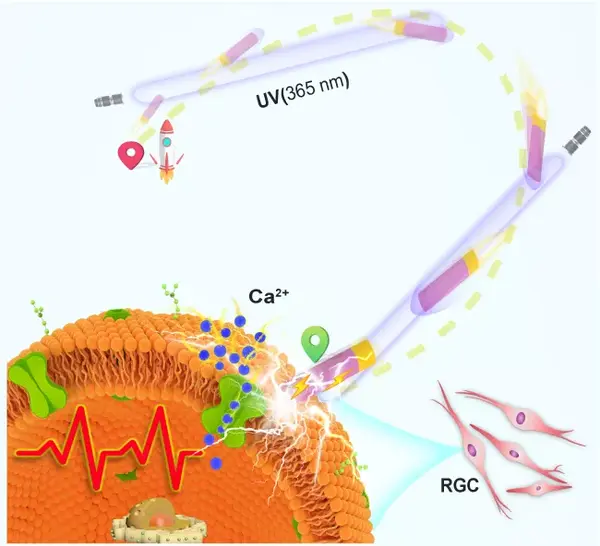
Visual impairment and even blindness have always been a major issue in medical treatment. The assisted activation of retinal ganglion cells RGCs contributes to the restoration of visual signal transduction circuits. According to reports, electrical stimulation produced by artificial photoreceptors can excite cells by opening calcium channels. However, the current artificial photoreceptor materials are bulky and require surgical implantation. Invasiveness is an inevitable major problem, which limits their application in organisms. In view of this, there is still a lack of a non-invasive and highly controllable method in the field of neurostimulation.
In order to solve this problem, the team cooperated and successfully constructed and demonstrated that a TiO2-Au nanowire NW motor driven by UV light 365 nm uses inherently generated photocurrent to achieve high-precision activation of the target RGC. Under UV light irradiation, through the synergistic effect of photoelectric effect and photochemical water splitting, the self-electrophoresis mechanism of the motor under the photoelectrochemical reaction establishes a local electric field on the entire TiO2-Au NW motor. By adjusting the direction of the light, the motor can be driven to target the target RGC cells with high precision. The photocurrent generated by the motor is then transmitted and successfully activates the RGC cells, thus realizing the signal transmission between the cells and the nanowires. Due to the small size and flexibility of NW and good semiconductor performance, the TiO2-Au motor effectively achieves nerve stimulation. The application of highly controllable motors also represents a new method of connecting the nervous system with superior temporal and spatial precision. We have proved for the first time that the motors photoelectric conversion ability, in addition to providing driving force, can also generate bioelectric signals to regulate neuronal activity, which is important for achieving precise, non-invasive biosignal transduction and communication with biological systems significance.
The School of Materials Science and Engineering, Sun Yat-sen University is the first unit of this article. Graduate student Chen Bin is the first author of this article. Professor Daniela A. Wilson of Nijmegen University participated in this research and is the co-author of the paper.
Original link:
https://onlinelibrary.wiley.com/doi/10.1002/adfm.202008667
This information is sourced from the Internet for academic exchanges. If there is any infringement, please contact us to delete it immediately
18915694570
Previous: Can anions be inserted