

Adv. Funct. Mater: Heterogeneous MXene/PS-b-P2VP nanofluidic membrane with controllable ion transmission for osmotic energy conversion
Membrane-based osmotic power harvesting is a strategy for sustainable power generation. Two-dimensional nanofluids with high ionic conductivity and selectivity are emerging candidates for osmotic energy conversion. However, ion diffusion under nano-constraint is hindered by uniform monotonic charge regulation and severe concentration polarization of the two-dimensional film, which leads to undesirable power conversion performance. This article reports an asymmetric nanochannel membrane with a two-layer structure, in which a two-dimensional transition metal carbide/nitride (MXenes) scale channel serves as a shielding layer to control ion transport, and a block copolymer (BCP) The nano-scale pores are pH-responsive arrays with ordered nano-shaped structures. This efficient osmotic energy generator can advance the basic understanding of the paradigm of mxene-based heterogeneous nanofluidic devices as membrane-based energy conversion technology.
Two, graphic guide
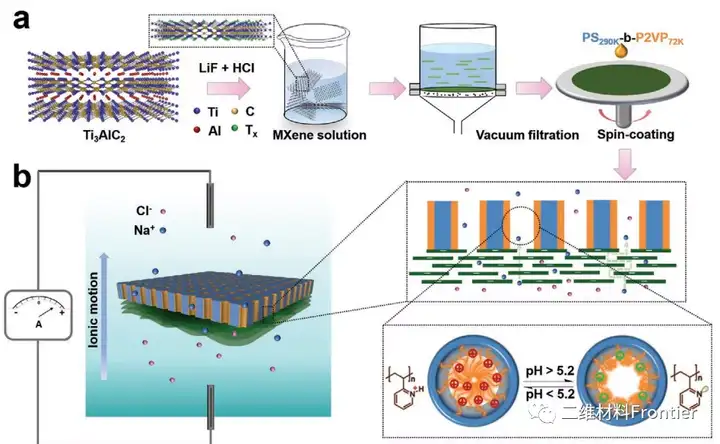
Figure 1. Schematic diagram of the manufacture of MXene/PS-b-P2VP heterogeneous osmotic generator.
In the above figure, a) Preparation of heterogeneous membranes. PS290000-b-P2VP72 000 Spin coating on the two-dimensional MXene membrane obtained by vacuum assisted filtration. b) Schematic diagram of osmotic energy conversion based on the concentration gradient of MXene/PS-b-P2VP heterogeneous membrane. PS-b-P2VP is relatively pH sensitive; therefore, the pore size and charge characteristics can be adjusted at different pH values, thereby adjusting the ion transport and permeation power generation capacity of the non-uniform nanochannel.
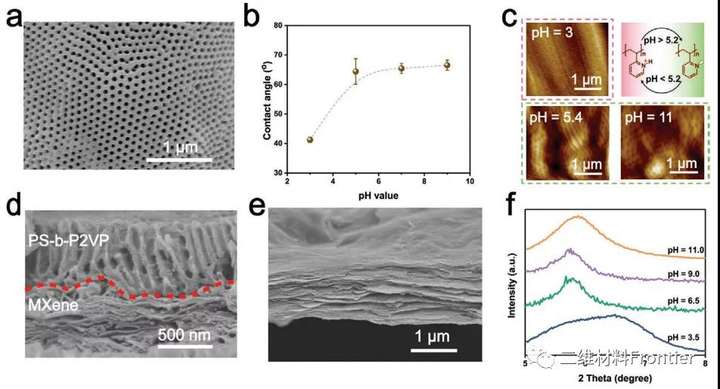
Figure 2. The structure characterization diagram of the material.
In the figure above, a) Scanning electron microscope image of the prepared PS-b-P2VP film on the MXene film. b) The contact angle of the PS-b-P2VP film surface under a series of pH values. c) The liquid phase AFM image of the PS-b-P2VP membrane immersed in a 0.01m sodium chloride aqueous solution, and the pH value is adjusted from 3.0 to 11.0. The different pore diameters are related to the protonation and deprotonation of the pyridine group (pKa≈5.2) on the P2VP chain. When the pH exceeds 5.2, the pore diameter rises sharply to ≈60nm. d) Cross-sectional scanning electron microscope image of MXene/PS-b-P2VP heterogeneous membrane. e) Cross-sectional image of the layered MXene film. f) XRD spectra of fully hydrated MXene membranes at different pH values.
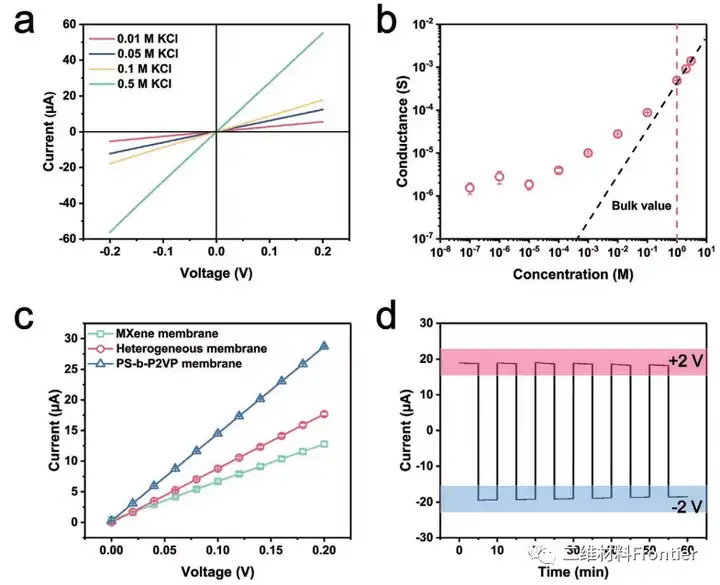
Figure 3. Ion transmembrane properties controlled by surface charge of MXene/PS-b-P2VP heterogeneous membrane.
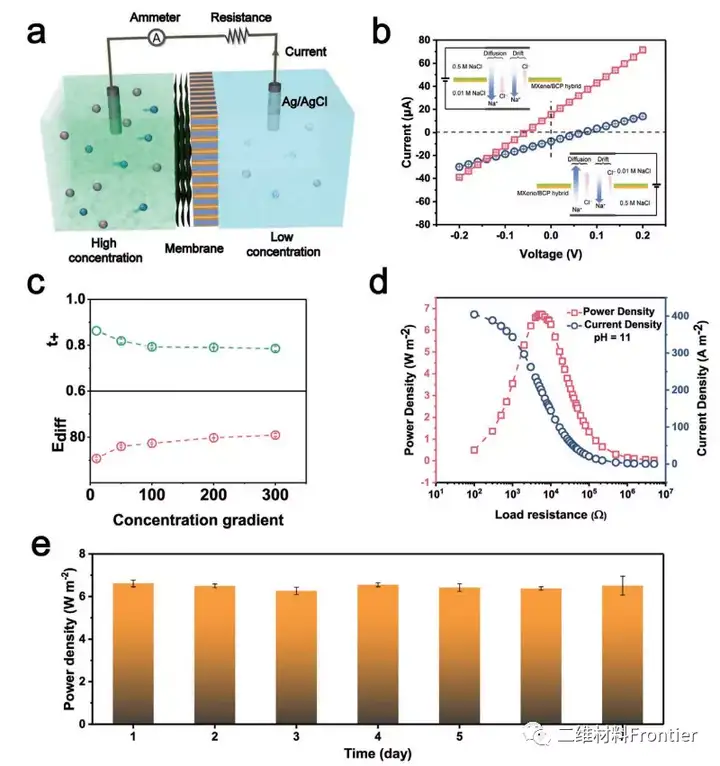
Figure 4. Schematic diagram of the principle of penetration power generation.
In the figure above, a) A schematic diagram of a self-made experimental device that collects osmotic energy and provides external load resistance. At pH 11, 50-fold gradient I-V curve in two configurations of forward and reverse diffusion. With a high concentration of sodium chloride solution (red curve) on the MXene side, the absolute value of Isc is 15.5μA. Under the potassium chloride salinity gradient at pH11, the calibrated diffusion potential (Ediff=VOC−Eredox) and the number of ion transfer across the membrane (t+) of the heterogeneous membrane. d) Output power density and current density as a function of load resistance at a concentration gradient of 50 times. When the load resistance is ≈5.5kΩ, the output power density reaches 6.74Wm−2. e) The stability of the membrane in the process of osmotic energy conversion.
3. Full text summary
In summary, a heterogeneous nanofluidic device based on mxene was fabricated through the ph-responsive BCP layer on top of the heterostructure. Due to the heterojunction with asymmetric nanochannels, chemical composition and adjustable surface charge density, a power density of up to 6.74Wm−2 was achieved in the simulated ocean/river water system. This asymmetric heterostructure impairs the concentration polarization bound by the uniform mxene structure due to the asymmetric charge and size distribution in a wide pH range. In addition, at high pH values, the transmembrane ion flux and selectivity of heterogeneous membranes are also improved. This work may create opportunities for efficient osmotic power generation in a wide pH range, especially for the osmotic energy conversion of industrial wastewater at extreme pH values.
In summary, a heterogeneous nanofluidic device based on mxene was fabricated through the ph-responsive BCP layer on top of the heterostructure. Due to the heterojunction with asymmetric nanochannels, chemical composition and adjustable surface charge density, a power density of up to 6.74Wm−2 was achieved in the simulated ocean/river water system. This asymmetric heterostructure impairs the concentration polarization bound by the uniform mxene structure due to the asymmetric charge and size distribution in a wide pH range. In addition, at high pH values, the transmembrane ion flux and selectivity of heterogeneous membranes are also improved. This work may create opportunities for efficient osmotic power generation in a wide pH range, especially for the osmotic energy conversion of industrial wastewater at extreme pH values.
Article link:
https://doi.org/10.1002/adfm.202105013
https://doi.org/10.1002/adfm.202105013
This information is sourced from the Internet for academic exchanges only. If there is any infringement, please contact us to delete it immediately.
18915694570
Previous: Nature: Design princip