

高效鈣鈦礦太陽能電池的1D協同MXene納米管混合物
First, an overview of the article,
The electron transport layer (ETL) with perovskite solar cells (perovskite solar cells) has been proved to provide efficient photovoltaic (PV) devices. However, the environmental manufacture of ETL leads to oxidation leading to the inevitable deterioration of the electrical properties of MXene. In this paper, ordered metal single-walled carbon nanotubes (m-SWCNTs) were used to prepare MXene/SWCNTs composites to improve the PV performance of perovskite solar cells. Through the optimized composition, more than 21% of the power conversion efficiency is achieved. Improved photoluminescence and reduced charge transfer resistance electrochemical impedance spectroscopy show that low trap density and improved charge extraction and transport properties are due to the existence of nanotubes and the reduction of defective tin oxide surfaces. The MXene/SWCNTs strategy reported in this paper provides a new way to realize high performance perovskite solar cells.
Second, guided reading of picture and text.
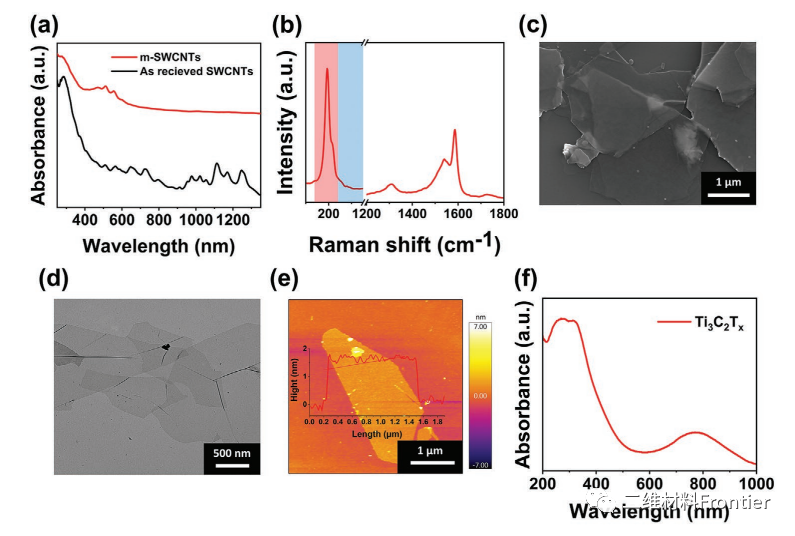
Figure 1.
A) SWCNTs absorption spectra before and after the separation process. B) Raman spectra of samples rich in m-SWCNT. C) SEM, d) TEM and e) AFM images of MXene slices processed by layers. F) Ultraviolet spectrum-relative to the spectrum of MXene solution.
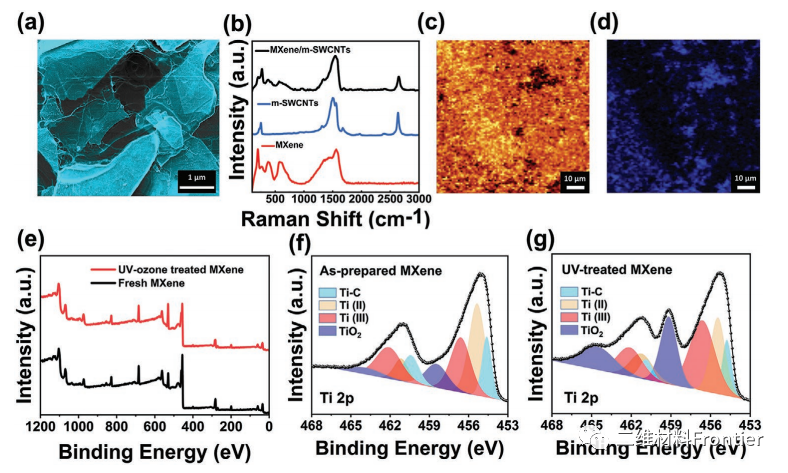
Figure 2.
A) it is a false color SEM image of MXene/m-SWCNTs mixture. B) Raman spectra of the mixture of MXene, m-SWCNTs and MXene/m-SWCNTs. The Raman mapping shows the distribution of c) MXene and (d) SWCNTs in the mixture collected under the wavelength laser of 532nm. F) latest MXene thin films and g) ultraviolet-ozone treated MXene thin films e) XPS measured spectra and high resolution XPS spectra.
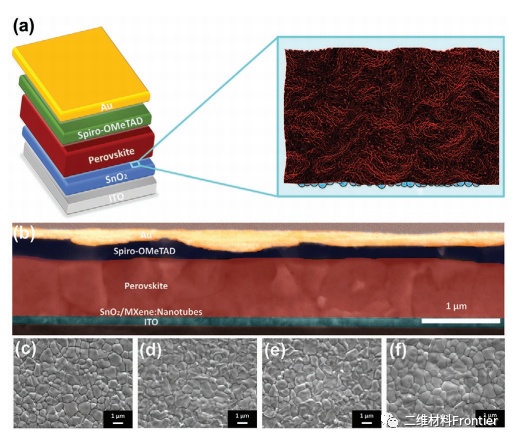
Figure 3.
A) A diagram of the structure of the device, showing the interface SNO2/CNT layer between ITO and perovskite. B) A cross-sectional SEM image of the device has been completed. Top view SEM image self-painted on c) naked tin oxide, d) MXene, e) m-SWCNt, f) Mxene/m-SWCNt.
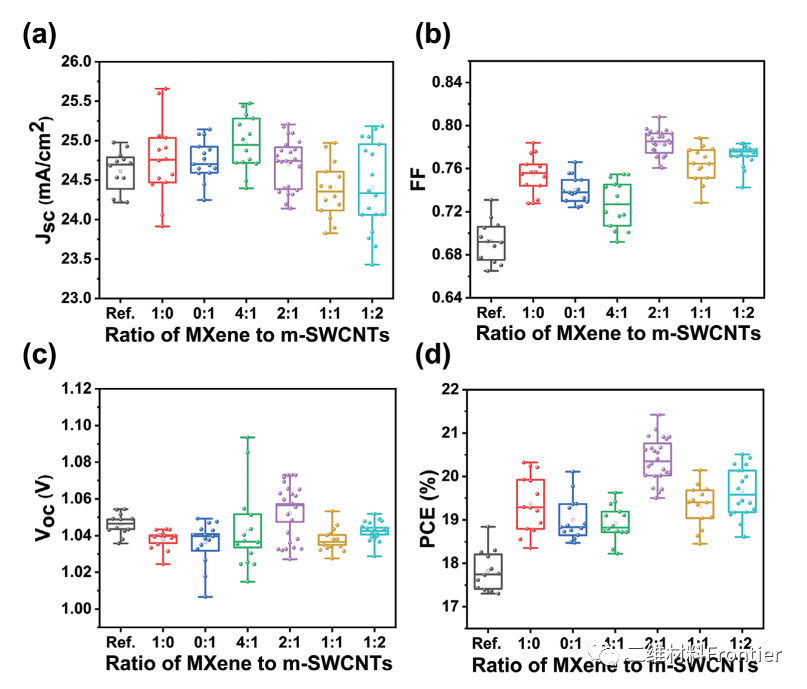
Figure 4.
Statistical distribution of a) Jsc, b) FF, c) Voc and d) PCE of solar cells manufactured using various MXene/m-SWCNT interface layers.
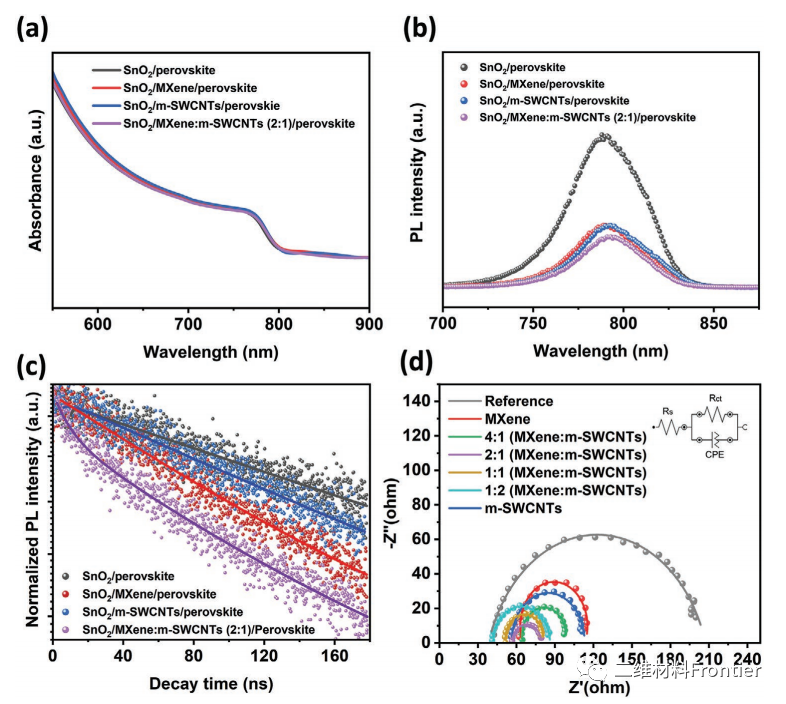
Figure 5.
A) Ultraviolet spectrum-visible absorption spectrum of tin oxide thin films with different interface layers. B) PL and c) TRPL decay spectra of perovskite films on ITO/SnO2/ perovskite, ITO/SnO2/ perovskite, ITO/SNO2/m-SWCNT/SNO2/m/ perovskite / INO2/MXene (2:1) / perovskite substrate. D) the EIS of perovskite solar cells combines different interface layers. The insert displays the equivalent circuit module for EIS assembly.
III. Summary of the full text.
To sum up, it is proved that the mixed deposition of MXENe on tin oxide layer can effectively improve the PV performance of perovskite solar cells. The comprehensive studies conducted by the authors using SEM, PL, TRPL and EIS show that the mixed interface layer of MXene/m-SWCNTs can reduce the defect density at the interface of tin oxide and perovskite, thus reducing the trap density and improving the extraction and transport of charge. The champion PSC made with MXene/m-SWCNT (2:1W/W) shows that the PCE exceeds 21% of the maths FF and approaches 0.80. This work shows that solving the solution of MXene/mSWCNTs hybrid system is a simple and effective method to realize high efficiency perovskite solar cells.
This information is from the Internet for academic exchange only. if there is any infringement, please contact us to delete it immediately.
18915694570
Previous: The first JACS Au hydr